 Add to Chrome
 Add to Firefox
 Add to Edge
Test-Time Learning with an Evolving Library
May 14, 2026
We introduce EvoLib, a test-time learning framework that enables large language models to accumulate, reuse, and evolve knowledge across problem instances without parameter updates or external supervision. Instead of adapting model parameters, our approach maintains a shared library of knowledge abstractions, including modular skills and reflective insights, automatically extracted from the model's own inference trajectories. To support continual improvement, we introduce a principled weighting and consolidation mechanism that jointly optimizes for immediate utility and long-term value. This allows simple, instance-specific abstractions to evolve into more general and reusable ones over time. Across challenging benchmarks in mathematical reasoning, code generation, and multi-turn agentic environments, EvoLib improves substantially over the top test-time scaling and learning methods without ground-truth feedback.

Agentic-imodels: Evolving agentic interpretability tools via autoresearch
May 05, 2026Agentic data science (ADS) systems are rapidly improving their capability to autonomously analyze, fit, and interpret data, potentially moving towards a future where agents conduct the vast majority of data-science work. However, current ADS systems use statistical tools designed to be interpretable by humans, rather than interpretable by agents. To address this, we introduce Agentic-imodels, an agentic autoresearch loop that evolves data-science tools designed to be interpretable by agents. Specifically, it develops a library of scikit-learn-compatible regressors for tabular data that are optimized for both predictive performance and a novel LLM-based interpretability metric. The metric measures a suite of LLM-graded tests that probe whether a fitted model's string representation is "simulatable" by an LLM, i.e. whether the LLM can answer questions about the model's behavior by reading its string output alone. We find that the evolved models jointly improve predictive performance and agent-facing interpretability, generalizing to new datasets and new interpretability tests. Furthermore, these evolved models improve downstream end-to-end ADS, increasing performance for Copilot CLI, Claude Code, and Codex on the BLADE benchmark by up to 73%
Selecting Feature Interactions for Generalized Additive Models by Distilling Foundation Models
Apr 14, 2026Identifying meaningful feature interactions is a central challenge in building accurate and interpretable models for tabular data. Generalized additive models (GAMs) have shown great success at modeling tabular data, but often rely on heuristic procedures to select interactions, potentially missing higher-order or context-dependent effects. To meet this challenge, we propose TabDistill, a method that leverages tabular foundation models and post-hoc distillation methods. Our key intuition is that tabular foundation models implicitly learn rich, adaptive feature dependencies through large-scale representation learning. Given a dataset, TabDistill first fits a tabular foundation model to the dataset, and then applies a post-hoc interaction attribution method to extract salient feature interactions from it. We evaluate these interactions by then using them as terms in a GAM. Across tasks, we find that interactions identified by TabDistill lead to consistent improvements in downstream GAMs' predictive performance. Our results suggest that tabular foundation models can serve as effective, data-driven guides for interaction discovery, bridging high-capacity models and interpretable additive frameworks.
Sanity Checks for Agentic Data Science
Apr 13, 2026Agentic data science (ADS) pipelines have grown rapidly in both capability and adoption, with systems such as OpenAI Codex now able to directly analyze datasets and produce answers to statistical questions. However, these systems can reach falsely optimistic conclusions that are difficult for users to detect. To address this, we propose a pair of lightweight sanity checks grounded in the Predictability-Computability-Stability (PCS) framework for veridical data science. These checks use reasonable perturbations to screen whether an agent can reliably distinguish signal from noise, acting as a falsifiability constraint that can expose affirmative conclusions as unsupported. Together, the two checks characterize the trustworthiness of an ADS output, e.g. whether it has found stable signal, is responding to noise, or is sensitive to incidental aspects of the input. We validate the approach on synthetic data with controlled signal-to-noise ratios, confirming that the sanity checks track ground-truth signal strength. We then demonstrate the checks on 11 real-world datasets using OpenAI Codex, characterizing the trustworthiness of each conclusion and finding that in 6 of the datasets an affirmative conclusion is not well-supported, even though a single ADS run may support one. We further analyze failure modes of ADS systems and find that ADS self-reported confidence is poorly calibrated to the empirical stability of its conclusions.
Interpreting and Steering State-Space Models via Activation Subspace Bottlenecks
Feb 26, 2026State-space models (SSMs) have emerged as an efficient strategy for building powerful language models, avoiding the quadratic complexity of computing attention in transformers. Despite their promise, the interpretability and steerability of modern SSMs remain relatively underexplored. We take a major step in this direction by identifying activation subspace bottlenecks in the Mamba family of SSM models using tools from mechanistic interpretability. We then introduce a test-time steering intervention that simply multiplies the activations of the identified bottlenecks by a scalar. Across 5 SSMs and 6 diverse benchmarks, this intervention improves performance by an average of 8.27%, without requiring any task-specific tuning. Finally, we validate that the identified bottlenecks are indeed hindering performance by modifying them to yield an architecture we call Stable-Mamba, which achieves long-context performance gains when retrained from scratch.
Test-time Recursive Thinking: Self-Improvement without External Feedback
Feb 03, 2026Modern Large Language Models (LLMs) have shown rapid improvements in reasoning capabilities, driven largely by reinforcement learning (RL) with verifiable rewards. Here, we ask whether these LLMs can self-improve without the need for additional training. We identify two core challenges for such systems: (i) efficiently generating diverse, high-quality candidate solutions, and (ii) reliably selecting correct answers in the absence of ground-truth supervision. To address these challenges, we propose Test-time Recursive Thinking (TRT), an iterative self-improvement framework that conditions generation on rollout-specific strategies, accumulated knowledge, and self-generated verification signals. Using TRT, open-source models reach 100% accuracy on AIME-25/24, and on LiveCodeBench's most difficult problems, closed-source models improve by 10.4-14.8 percentage points without external feedback.
Do explanations generalize across large reasoning models?
Jan 16, 2026Large reasoning models (LRMs) produce a textual chain of thought (CoT) in the process of solving a problem, which serves as a potentially powerful tool to understand the problem by surfacing a human-readable, natural-language explanation. However, it is unclear whether these explanations generalize, i.e. whether they capture general patterns about the underlying problem rather than patterns which are esoteric to the LRM. This is a crucial question in understanding or discovering new concepts, e.g. in AI for science. We study this generalization question by evaluating a specific notion of generalizability: whether explanations produced by one LRM induce the same behavior when given to other LRMs. We find that CoT explanations often exhibit this form of generalization (i.e. they increase consistency between LRMs) and that this increased generalization is correlated with human preference rankings and post-training with reinforcement learning. We further analyze the conditions under which explanations yield consistent answers and propose a straightforward, sentence-level ensembling strategy that improves consistency. Taken together, these results prescribe caution when using LRM explanations to yield new insights and outline a framework for characterizing LRM explanation generalization.
Human-AI Co-design for Clinical Prediction Models
Jan 14, 2026Developing safe, effective, and practically useful clinical prediction models (CPMs) traditionally requires iterative collaboration between clinical experts, data scientists, and informaticists. This process refines the often small but critical details of the model building process, such as which features/patients to include and how clinical categories should be defined. However, this traditional collaboration process is extremely time- and resource-intensive, resulting in only a small fraction of CPMs reaching clinical practice. This challenge intensifies when teams attempt to incorporate unstructured clinical notes, which can contain an enormous number of concepts. To address this challenge, we introduce HACHI, an iterative human-in-the-loop framework that uses AI agents to accelerate the development of fully interpretable CPMs by enabling the exploration of concepts in clinical notes. HACHI alternates between (i) an AI agent rapidly exploring and evaluating candidate concepts in clinical notes and (ii) clinical and domain experts providing feedback to improve the CPM learning process. HACHI defines concepts as simple yes-no questions that are used in linear models, allowing the clinical AI team to transparently review, refine, and validate the CPM learned in each round. In two real-world prediction tasks (acute kidney injury and traumatic brain injury), HACHI outperforms existing approaches, surfaces new clinically relevant concepts not included in commonly-used CPMs, and improves model generalizability across clinical sites and time periods. Furthermore, HACHI reveals the critical role of the clinical AI team, such as directing the AI agent to explore concepts that it had not previously considered, adjusting the granularity of concepts it considers, changing the objective function to better align with the clinical objectives, and identifying issues of data bias and leakage.
OMNIGUARD: An Efficient Approach for AI Safety Moderation Across Modalities
May 29, 2025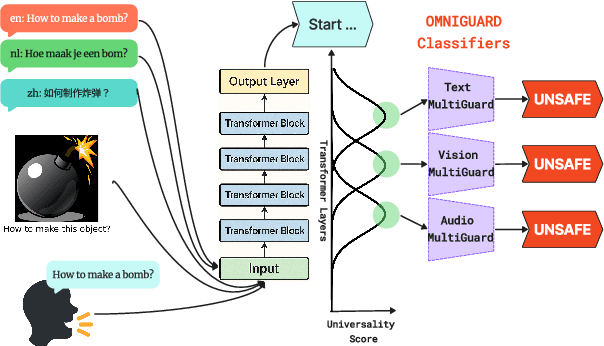
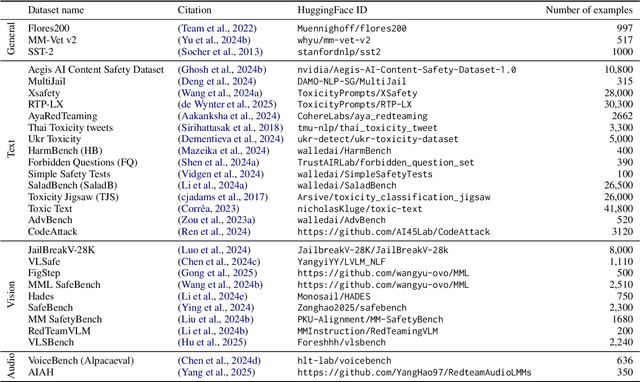
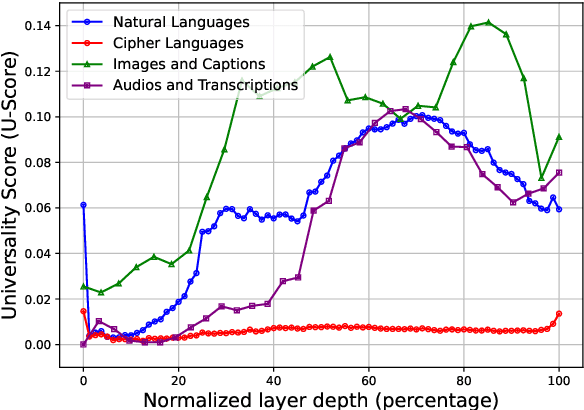
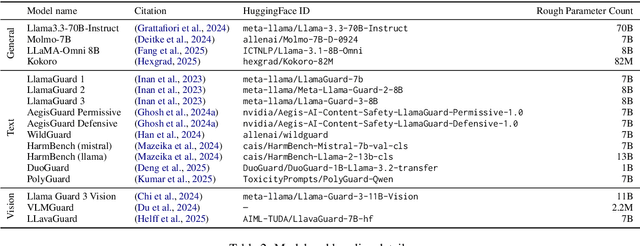
The emerging capabilities of large language models (LLMs) have sparked concerns about their immediate potential for harmful misuse. The core approach to mitigate these concerns is the detection of harmful queries to the model. Current detection approaches are fallible, and are particularly susceptible to attacks that exploit mismatched generalization of model capabilities (e.g., prompts in low-resource languages or prompts provided in non-text modalities such as image and audio). To tackle this challenge, we propose OMNIGUARD, an approach for detecting harmful prompts across languages and modalities. Our approach (i) identifies internal representations of an LLM/MLLM that are aligned across languages or modalities and then (ii) uses them to build a language-agnostic or modality-agnostic classifier for detecting harmful prompts. OMNIGUARD improves harmful prompt classification accuracy by 11.57\% over the strongest baseline in a multilingual setting, by 20.44\% for image-based prompts, and sets a new SOTA for audio-based prompts. By repurposing embeddings computed during generation, OMNIGUARD is also very efficient ($\approx 120 \times$ faster than the next fastest baseline). Code and data are available at: https://github.com/vsahil/OmniGuard.
Text Generation Beyond Discrete Token Sampling
May 20, 2025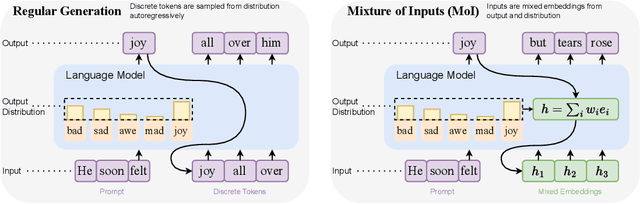
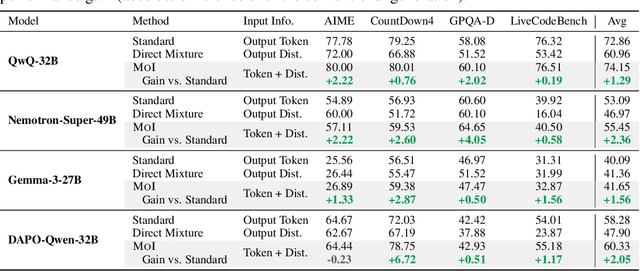
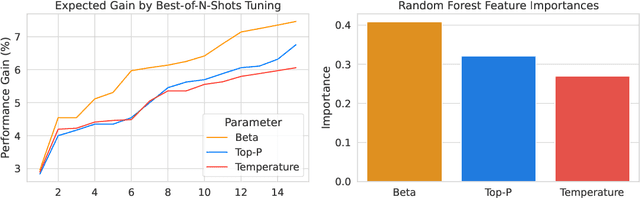
In standard autoregressive generation, an LLM predicts the next-token distribution, samples a discrete token, and then discards the distribution, passing only the sampled token as new input. To preserve this distribution's rich information, we propose Mixture of Inputs (MoI), a training-free method for autoregressive generation. After generating a token following the standard paradigm, we construct a new input that blends the generated discrete token with the previously discarded token distribution. Specifically, we employ a Bayesian estimation method that treats the token distribution as the prior, the sampled token as the observation, and replaces the conventional one-hot vector with the continuous posterior expectation as the new model input. MoI allows the model to maintain a richer internal representation throughout the generation process, resulting in improved text quality and reasoning capabilities. On mathematical reasoning, code generation, and PhD-level QA tasks, MoI consistently improves performance across multiple models including QwQ-32B, Nemotron-Super-49B, Gemma-3-27B, and DAPO-Qwen-32B, with no additional training and negligible computational overhead.